
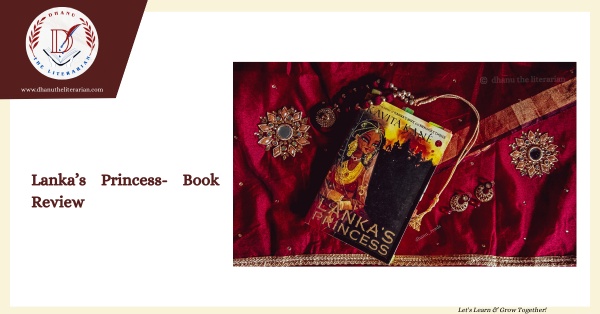
Novel : Lanka’s Princess
Author : Kavita Kané
Publication: 2017, Rupa Publications, India
Price : 142
Genre : Indian Mythological fiction
Pages : 298
Blogpost by Dhanu
Surpanakha- human or demoness
Content 5🌟/5
Cover Design 5🌟/5
Surpanakha, the name immediately raises the thoughts like the one who was the reason behind the war between Ram and Ravan. Other than that, we can imagine her as a voluptuous, demonic and ruthless woman. Are we sure? Was she really like that or portrayed so? Here, in this novel, we can find all the answers and also can witness a new Surpanakha as Meenakshi, as she was originally named.
The novel Lanka’s Princess is about the story of Surpanakha, by Kavita Kané, the Indian mythological fiction writer. Lanka’s Princess can be taken as a revisiting or revision work of art of The Ramayana rather than as the retelling of the Indian Mythology. The entire novel conveyed through Meenakshi’s perspective. Kané made this novel as the dais for Surpanakha to justify her. The novel echoes with her rants, betrayal and loss of life.
In this novel, Surpanakha is more portrayed as Meenakshi than as Surpanakha. Surpanakha was first originally presented in the Indian epic, The Ramayana as the sister of the mighty Sri Lankan King Ravan.
The history portrays Surpanakha as the dark villainy and malicious woman and there is no chance given to her to explain herself. Kavita Kané takes the steps to give her chance by telling the story from her side. To explore more shadowed mythical female characters, Kané created a brand new dimension of the moulded female characters from Indian Mythologies.
The novel begins with the introduction of the next birth of Surpanakha as Kubja the hunchback, the result of her misdeeds and Lord Krishna relieve her from the sufferings and tells the story about her previous birth.
The novel gradually centers back to the previous birth of Kubja as Surpanakha. The entire novel highlights the journey of the character from the birth as Meenakshi to her transformation as Surpanakha. This novel discloses the conspiracies around the character, Surpanakha. Many writers have portrayed her as a vulnerable character in their works. Only Kané sees her as a woman and humanizes Surpanakha into Meenakshi.
The readers can thoroughly enjoy the process of humanizing Surpanakha. Each incident specifies the justification of the character role. However, the exaggeration supernatural power of the characters was not taken into consideration. Along with Surpanakha, other characters are also meant to be picturized in humanic figures. Because Kané’s Surpanakha created an impact on me to analyze deep before act.
The language used in this novel is chatty and well-turned. In one or two places, it gives the feeling of rambling. I am actually took this piece of writing for my project as a primary source. The style of writing help me in many ways and kept me on the track. I’m much obliged for Kané’s works.
I highly, highly recommend this novel, if you want to know more about Surpanakha.

