
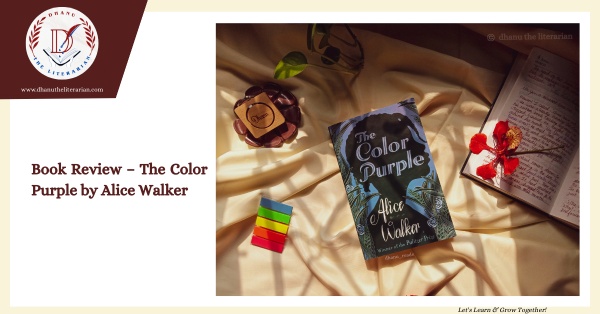
✨Book : The Color Purple
✨Author : Alice Walker
✨Genre : American Classic, Post-modern feminism, Epistolary Fiction
✨Pages : 261
✨Publication: Weidenfeld & Nicolson
✨Format : paperback
✨Book Cost : ₹399
Blogpost by Dhanu
4.9/5
TW: Racism, rape, patriarchy, denial, domestic violence, misogyny, failed marital relationships
Ever since I wanted to read this book, I had been putting off getting or reading this book. Eventually my best friend gifted me this book for my last birthday. After putting off reading the same book since October, I eventually picked it up for my March month read (I hope you know why). And I started to scream, cry and often appalled by the facts which I had been putting off believing them. Initially, I was struggled to read this novel and by the end I wanted to unread the same. But you know that the truths cannot be ignored or vanished, moreover you have to accept them.
The narration begins with Celie, the young protagonist in her age fourteen who is penning her life incidents in the form of letters to God in her broken English. The story begins when Celie is in her teenage and travels towards her middle age. The novel starts with the incident of Celie’s innocence seized by her step-father along with the presence of her mother. And her two children were taken away from her shortly after they were born. Even in her distress, Celie tries hard to save her sister, Nettie from the brutality that has befallen her.
The women in the novel take care for each other woman in their brutal lives and have each other’s shoulder for their solace and happiness. Another significant consideration in this novel is that Celie’s refusal to mention the name of elder men around her whereas the other female characters have no such qualms. Celie is devotedly being the typical woman who wants to spend her life devotedly for her husband’s commands. She gradually evolved in her life and began to address her letters to Nettie rather than God whose presence she devoured.
There are letters from her younger sister, Nettie which addresses Celie. The difference in Nettie’s letters to her sister is her maturity in the way she goes through the hurdles in her life and her writing is also quite structured. Not only in Celie, but also the readers can easily witness the change in the nature of the third generation men in the novel and the men who were misguided by their misogynistic behaviours.
Celie has insecurities about her skin, the way she speaks, the way she takes care for herself, her intellect and everything that concerns and differs her from other women. She always compares herself with the character named, Shug Avery, the famous local singer. Celie admires Shug Avery and aspires to be like her. But in true, she is more than everyone else in this novel. She has the ability of turning the ripped into new and broken into art. With her soulful touch, she transforms a house into a home and intransigence into love.
Apart from Celie, every female character such as Nettie, Shug Avery, Sofia, Corrine is portrayed with the self-awareness and fights for her gender role. Above all, these female characters are not much appreciated by the male characters in the novel and they often get into trouble for standing for themselves. Most of all, these female characters valued education and self-respect which were denied for them.
This novel is set in South America and starts in 1930s with the depiction of Black people’s life and their slavery by the white people . The writing style of this novel is unique that it projects the innocence in the life of uneducated Celie. The timeline of this novel cannot be guaranteed as it travels for such a long, sometimes the age of the characters are not so vivid but that does not matter because the change in the season of life of each character is narrated with ease.
The language of this novel is crooked yet has its depth with the narration of each incident. Because of the author’s use of Celie’s broken language, the novel is bit of difficult to understand the context. But the emotions and pain of the characters are consistently expressed. The novel was awarded the prestigious Pulitzer Prize and was adapted into a movie.
And I highly recommend this novel for everyone.
Happy Reading!
x Dhanu
Book Review – The Color Purple by Alice Walker
Share this content

